
If you’re reading this article, you probably know the struggles of managing finances of a group with two or more entities all too well. Subsidiaries are running their own accounting software, and each one has been set up independently by different accounts, with different naming conventions and account structures - for example, one entity might code rent as “Office Lease Expense” and another might call it “Occupancy Costs”.
Every month, you’re trying to pull together a cohesive view of the group as a whole, and your finance team is spending hours manually mapping, reconciling, and cross-referencing accounts before any numbers can even appear in a report. This is just the reality for many growing multi-entity businesses, but it’s solvable with a Common Chart of Accounts (CCOA).
What is a Common Chart of Accounts?
A Common Chart of Accounts (CCOA) is a set of account codes and categories that apply consistently across all entities within a multi-entity business. The intention is not to replace each entity’s local chart of accounts, but instead, it acts as a mapping layer that sits between local accounts and the reporting structure. Each local account is mapped to a corresponding CCOA account, allowing financial data from different entities, accounting systems, and account structures to be translated into a consistent format.
This is particularly important in multi-entity accounting because subsidiaries may record the same transactions differently. One entity might record revenue under a single account, while another splits it across several. A CCOA ensures these accounts are mapped to the same group-level categories, creating a consistent financial structure across the business.
Local vs Common Chart of Accounts
A local Chart of Accounts determines how an individual entity records its finances. Meanwhile, a Common Chart of Accounts determines how that information is standardised across the group for reporting and consolidation.
Why multi-entity businesses need a Common Chart of Accounts
As businesses grow across multiple entities, differences in your Common Chart of Accounts can make group reporting very tricky. A CCOA creates a consistent structure for bringing that financial data together, helping finance teams to:
Report consistently across entities - Financial data is classified using the same group-level categories, even when subsidiaries use different account names, codes, or accounting systems.
Compare financial data more easily - A common structure makes it easier to compare like-for-like performance across entities, regions, and business units.
Consolidate more efficiently - With local accounts already mapped to a shared structure, less time is spent reclassifying data before consolidation.
Reduce manual data preparation - Established mappings can be reused during each reporting period, reducing repetitive spreadsheet work and inaccuracies.
The impact of manual data preparation is significant: In a study of 100 finance professionals, Aqilla found that data collection and imports are among the most time-consuming activities across month-end close, reporting, and analysis.
Principles for designing a Common Chart of Accounts
A well-designed CCOA must be easy to maintain, and while the right structure will depend on your business and reporting requirements, these are the core principles to follow:
Start with your group reporting requirements: Work backwards from the information you need to report and analyse at group level. Your financial statements, management reports and KPIs should help determine the categories and level of detail your CCOA needs.
Keep the account structure simple: More accounts don't necessarily mean better reporting. Avoid creating separate accounts for every department, location or project where dimensions or cost centres could capture that information instead. This keeps the CCOA manageable without limiting analysis.
Create clear naming and coding conventions: Use a consistent approach to account names, codes and categories so the structure is easy to understand and apply across entities. Clear conventions also make it easier to map local accounts to the correct group-level account.
Build for flexibility and growth: Your CCOA needs to accommodate differences between entities without forcing them to use identical local Charts of Accounts. It should also be flexible enough to incorporate new entities and changing reporting requirements without needing to be continually redesigned.
Putting a Common Chart of Accounts into practice with Aqilla
For multi-entity businesses, the systems used to design a Common Chart of Accounts structure can be the difference between streamlined group reporting, and another layer of manual work.
Aqilla supports multi-entity accounting within one unified system, bringing multiple companies and their financial data into one shared environment. Now, finance teams can maintain visibility across not only individual entities, but also group-level information can be accessed when needed for reporting and consolidation purposes. Multi-currency accounting is also supported in Aqilla at group, company, and site level.
As part of our implementation process, new customers are supported through their initial setup. Aqilla’s consultants, support, and development teams work with businesses to understand their reporting requirements and establish a CCOA structure customised to their needs, helping them to put the foundations down for consistent reporting in place from the get-go
Here is an example of how a Chart of Accounts can be structured in Aqilla:
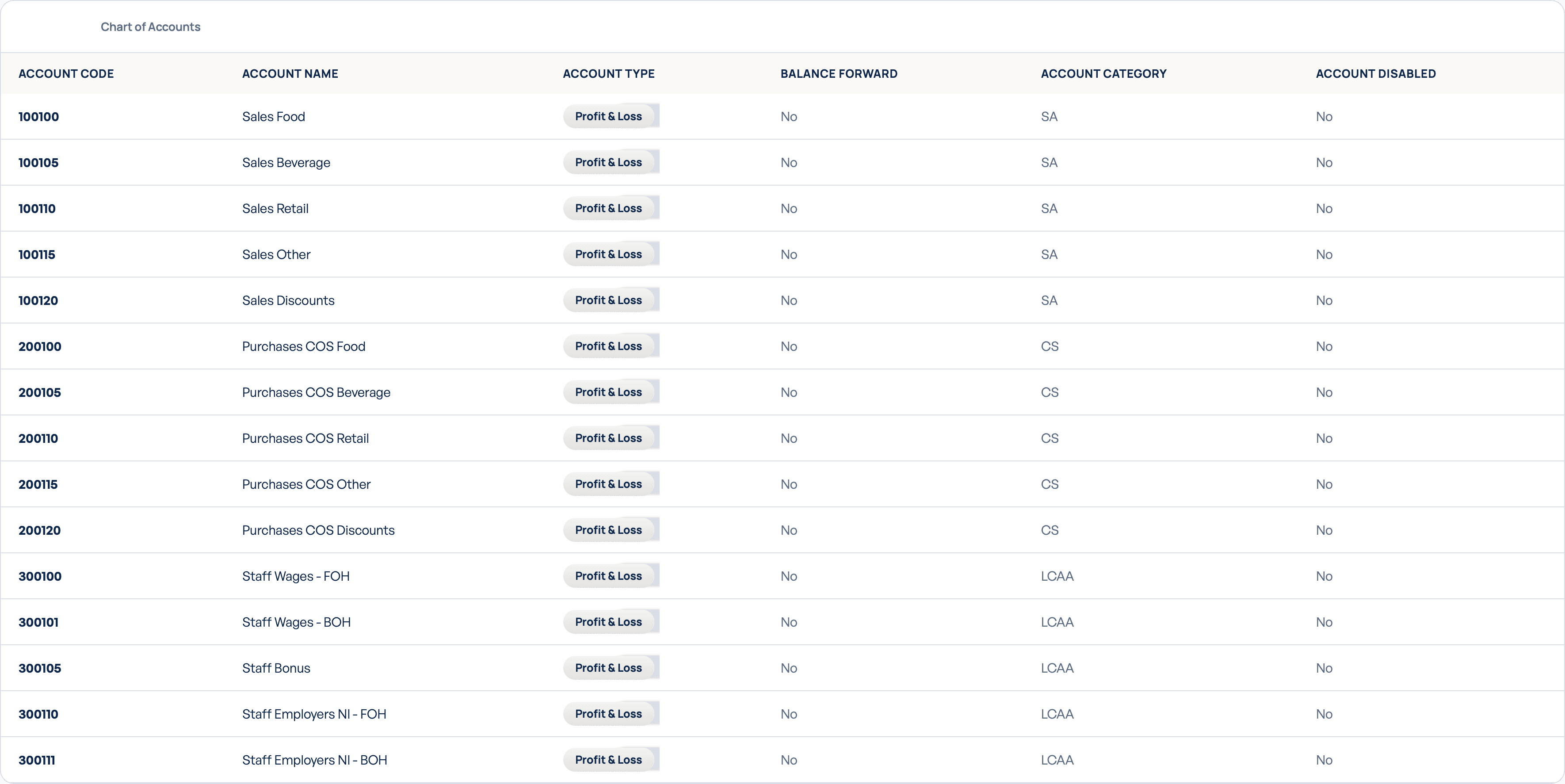
Example of a Chart of Accounts configured in Aqilla, showing standardized account codes, names and categories.
Multi-entity reporting in practice
For London Treasury, the GLA’s (Greater London Authority) investment and treasury arm, Aqilla provides a single accounting platform for managing its six entities, giving the finance team a consistent approach to financial management across the organisation.
Aqilla also supports group reporting and consolidation where entities operate across separate instances. Financial data from multiple companies can be brought together using Aqilla’s group ledger and reporting tools, helping to streamline group reporting and reduce the complexity of managing financial information across separate entities.
Reducing the month-end workload
Take Premier Gateway International for example, a multi-entity specialist totalisator wagering business, that moved its finance processes from Sage 200 to Aqilla, and reduced its month-end close by three days.. This demonstrates the long-term benefits of a structured approach to financial data combined with reporting and automation tools: finance teams can spend less time on admin preparing numbers, and more time on data analysis.
Build a stronger foundation for multi-entity reporting
A Common Chart of Accounts can bring a lot of clarity to the complexities of multi-entity accounting. But the key to its success is designing a structure around the information your business needs, while making it flexible enough to service its purpose across different entities and adapting as the group grows.
All you need is the right system and structure in place, so that your finance team can create a reliable foundation for reporting, consolidation, and analysis.
Aqilla brings multi-entity accounting into a singular system, with all of the flexibility and reporting tools your finance team needs to manage complex group structures.ith support available during implementation, you don’t have to work out the right Chart of Accounts structure alone.
Ready to simplify multi-entity accounting? Book a demo to see how Aqilla could support your business.