🏆 Aqilla wins at the Cloud Excellence Awards 2026. Find out more

For project-based organisations, having a clear view of costs, income, and profitability across each project gives you greater control over business performance whilst helping to identify where action is needed. Without oversight of projects, that view can become blurry when financial and project information is spread across multiple systems and processes.
Finance software with built-in project accounting brings all of that information together. With Aqilla, project activity and financial data sit within the same system, creating a stronger foundation for oversight and decision-making.
Why bring project accounting and finance together?
Project accounting becomes more valuable when it forms part of the wider financial picture. Bringing together project and finance data means you are no longer moving information from one system to another, therefore you’re cutting down on manual processes and the potential for inconsistencies.
When you’re overseeing multiple projects, small gaps in information can make it tricky to see how the business is performing as a whole and this detail is important. Bringing project and finance data into the same system reduces the need to transfer, reconcile, and re-enter information between different platforms. Sounds tedious, doesn’t it?
Not only that, but project accounting software can reduce the administrative burden on your finance team. Aqilla ran a study on 100 finance and accounting professionals which showed that they’re spending 90% of time on data entry, leaving only 10% for data analytics. Prioritise this, and you’ll give your staff more time to focus on analysing numbers and providing insight that supports business decisions.
Understand the true cost and profitability of every project
Revenue isn’t the only symbol of the profitability of a project. Understanding the margin you’re achieving means accounting for the costs involved in delivering each project – from employee time and expenses to other project-specific costs.
Bringing these costs together with project income makes it easier to see whether your costs are in line with budgets, how margins are developing, and where a project may be less profitable than expected.
That gives you the opportunity to act earlier – whether that means addressing cost changes, how a project is resourced, or applying what you’ve learned to inform the pricing and planning of future work.
Bringing project costs together in one system
Aqilla’s project accounting capabilities are built within its finance system, allowing the information behind your project costs to form part of the same financial system rather than being managed separately.
Take employee time for example. Timesheets can be recorded against individual projects, while hourly rates can be used to calculate timesheet charges. Once processed, this information can feed into the ledger alongside other project-related financial data.
Expenses can also be assigned to projects in Aqilla, helping you account for an important part of the cost of delivery without having to manage that information through a separate process.
Bringing these elements together into one system creates a direct link between the activity taking place on a project and its financial records. Recording time and expenses against the relevant project helps to ensure these costs are accounted for when reviewing how much the delivery cost of the project was.
Make faster, more confident decisions with better project data
Making timely decisions relies on being able to go between the numbers, and the reasons behind them, without any unwanted delay. When the detail you need is always accessible, you can spend less time gathering information or looking for explanations, and more time deciding on what action should be taken.
Aqilla allows you to analyse financial data by project and other dimensions, with access to the detail behind the figures when they need further investigation. This can help you to understand what is driving a particular result without having to piece together information from different sources.
With that context available at the click of a button, decisions around costs, resources, and priorities can be based on a clearer understanding of what is happening and why – helping you respond faster, with more confidence.
Project accounting in practice: How offshore energy company Sembmarine SLP uses live project performance data
Sembmarine SLP designs and develops structures for the offshore energy industry, working with clients on a project basis. Easy access to financial information helps the business to track costs, forecast risk and identify potential issues early.
With Aqilla,Sembmarine is bringing its financial reporting by tracking and forecasting costs against targets. They have also been developing dashboards that can combine its financial information with relevant data from other areas of the business, helping provide a broader view when monitoring projects.
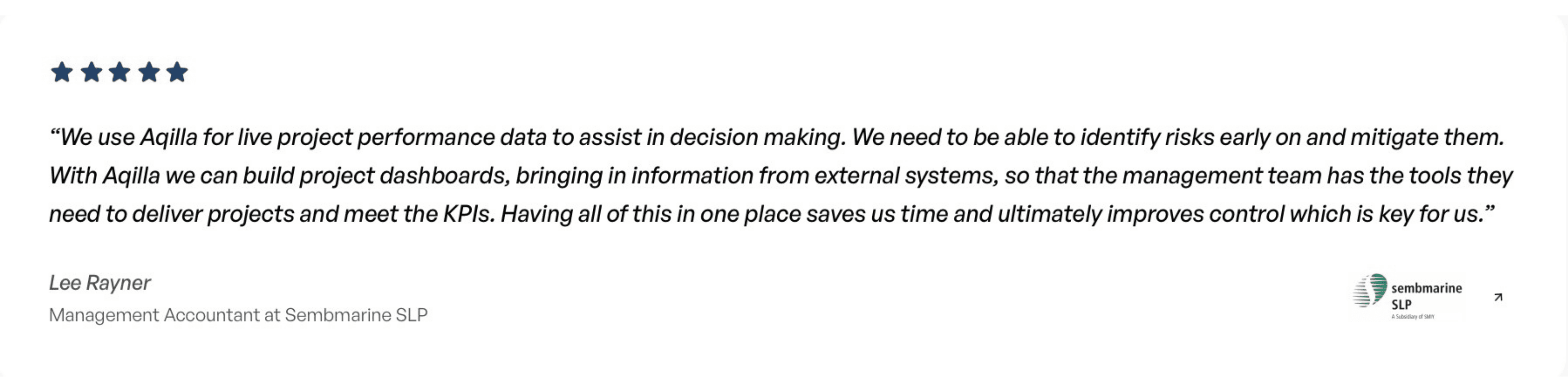
Management Accountant at Sembmarine SLP, Lee Rayner, says:
Using APIs to bring project data into Aqilla
Project accounting doesn’t always happen within one system. You may already use specialist project management or other operational tools to manage different parts of a project while relying on your finance system for the financial picture.
Aqilla’s API enables external applications to integrate with Aqilla, allowing finance data to connect with third-party systems like CRMs,eCommerce platforms and other custom or operational tools. Data can be created, read, updated and deleted through the API, helping information move between systems without relying on repeated manual entry.
For project-focused businesses, this means Aqilla can form part of a connected technology setup rather than requiring every aspect of project management to sit within the finance system. Relevant information from other business systems can feed into Aqilla, supporting reporting and giving finance teams a more joined-up view of project performance.
When your finance requirements go beyond project accounting
Project accounting is just one part of the wider financial picture. As requirements become more complex, capabilities such as reporting, consolidation, financial controls and multi-entity accounting can become increasingly important.
For organisations with more complex requirements, Aqilla goes beyond project accounting, bringing reporting, consolidation, financial controls and multi-entity accounting together in one system.
Better project insight starts with connected finance
Project accounting is more useful when it is treated in the same way as your other financial information. Bringing the two together provides a clear overview of costs, margins, and where action is needed.
With project accounting built into its finance platform, Aqilla connects the detail behind your projects with the details you rely on to keep the business running smoothly. Spend less time piecing the numbers together, and become more confident in making informed decisions.